
Posted by Electric Solenoid Valves on Mar 12th 2026
Anti-Corrosive Solenoid Valves: When PTFE Is The Right Choice
Anti-Corrosive PTFE Solenoid Valves Explained: The Solution for Corrosive Fluid Applications
Corrosive fluids do not slowly wear valves down. They attack them. Chemical exposure can pit internal passages, degrade seals, cause sticking, and shorten service life far faster than most users expect.
In many failure cases, the issue is not wiring, voltage, or thread type. It is material selection. More specifically, it is choosing a valve that looks chemically resistant on paper, only to discover that one wetted component, often the seal, is the weak link.
This is why anti-corrosive solenoid valves exist as a distinct category. These valves are designed to reduce chemical exposure by using chemically resistant body materials, such as PTFE, combined with carefully selected internal components to limit corrosion-related failure modes.
In this guide, we explain when a PTFE-body solenoid valve with a Viton seal is the right choice, its limits, and how to spec it correctly to avoid leaks, premature failures, and returns.
What “Anti-Corrosive” Really Means for Solenoid Valves
In valve applications, anti-corrosive does not simply mean “plastic body.” It means all wetted materials are selected to resist chemical attack from the media being controlled.
Corrosion in solenoid valves is not cosmetic. It directly affects valve performance and reliability. In corrosive service, chemical attack commonly leads to:
- Pitting at ports and sealing surfaces that lead to leaks
- Particle buildup inside the valve that causes a slow response or sticking
- Seal degradation where elastomers swell, harden, or crack
- Reduced service life in dosing systems and chemical rooms
Because these effects occur internally, corrosion-related failures are often misdiagnosed as electrical or control issues when the root cause is material incompatibility.
For corrosive service, material selection must consider the entire wetted stack, not just the valve body. This includes sealing elements, internal flow surfaces, and any components exposed to the process fluid during normal operation.
Why Chemical Compatibility Is Valve-Specific
Two valves can share the same port size, voltage, and pressure rating yet behave very differently in chemical service.
That is because chemical compatibility is driven by:
- Body material
- Seal material
- Any internal components that contact the fluid
Even when a valve body itself is chemically resistant, failure can occur if a single wetted component, such as a seal, seat, or internal surface, is incompatible with the fluid. In solenoid valves, these internal elements are often exposed repeatedly during actuation, accelerating chemical attack compared to static components.
This is why anti-corrosive solenoid valves are typically purpose-built, rather than modified from a general-purpose design. Their material selection and internal geometry are intended to reduce chemical exposure across the entire wetted path, not just the outer housing.
Our PTFE Anti-Corrosive Solenoid Valves at a Glance
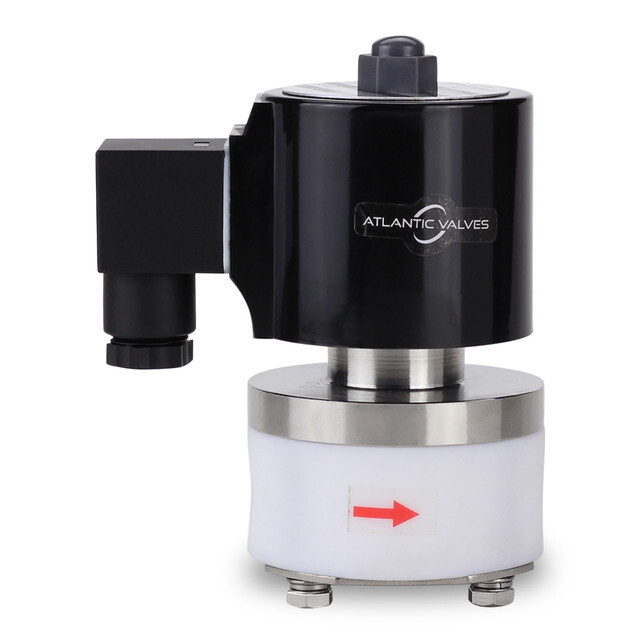
This PTFE line is designed for corrosion-resistant on and off control in low to moderate pressure applications where electrical actuation and compact installation are required.
The design targets low to moderate pressure service where corrosion resistance is required at the valve body and internal flow surfaces, while maintaining reliable solenoid operation under properly specified conditions.
Key design features
- 2-way, normally closed configuration
- Direct-acting operation, suitable for low differential pressure applications
- PTFE body and internal components, to reduce chemical attack on primary wetted surfaces.
- Viton (FKM) sealing for compatibility with a wide range of chemicals
- Continuous duty rated, suitable for extended energized operation
- Fast response
Coil and connection
- DIN 43650A connector
- IP65 sealed coil
- Class H insulation for elevated temperature tolerance
If you need a refresher on how direct-acting solenoid valves work, start with our solenoid valve basics guide.
Sizes, Voltages, and Operating Limits
Port sizes
- 3/8", 1/2", 3/4", 1" female NPT
Voltage options
- 110VAC
- 220VAC
- 24VDC
Media temperature range
- 15°F to 175°F, per published specification
Pressure Ratings by Size
Pressure capability is size-specific. Do not assume larger ports mean higher pressure ratings.
|
Port Size |
Pressure Range |
|
3/8" NPT |
0–29 psi |
|
1/2" NPT |
0–29 psi |
|
3/4" NPT |
0–14.5 psi |
|
1" NPT |
0–14.5 psi |
If your system can spike above these limits, select a different valve with appropriate margin.
Why PTFE Is Used in Corrosive Service
PTFE is widely used in chemical service applications because of its strong resistance to a broad range of corrosive media. In solenoid valve designs, it is commonly selected for wetted body components where chemical attack, scaling, or surface degradation would quickly damage metallic materials.
Key reasons PTFE is used in corrosive service include:
- High resistance to many corrosive substances
- Low surface friction that reduces sticking
- Long-term stability in harsh atmospheres
PTFE performs particularly well where metals would pit, scale, or corrode.
Important clarification
PTFE protects the valve body and primary flow surfaces; it does not protect every wetted component. Seals, seats, and other internal elements remain directly exposed to the process media.
In many corrosive applications, seal compatibility ultimately determines the valve's success or failure, regardless of the body material. A PTFE valve body can remain intact while an incompatible seal swells, hardens, or degrades, leading to leakage or loss of function.
For this reason, PTFE should be viewed as part of a material system, not a standalone solution. Proper specification must always consider the complete wetted stack, operating temperature, pressure, and duty cycle.
The Critical Detail People Miss About PTFE Valves
A common assumption sounds like this:
“PTFE is chemically resistant, so it should work.”
The reality is simpler and more restrictive.
A solenoid valve is not a single material; it is an assembly of multiple wetted components. Chemical compatibility is determined by every material exposed to the process fluid, not just the valve body.
In practice:
- A valve is not one material
- Wetted materials include the body, seals, and internal components
- Even with a PTFE body, the seal may be the limiting factor
For this valve line, the seal material is Viton (FKM).
Viton performs very well with many oils, fuels, and industrial fluids. It is not universally compatible, especially with strong acids, strong bases, and aggressive solvents.
For a deeper overview of seal selection, see our guide to valve seal materials.
What Counts as Wetted Materials
Wetted materials include every component that contacts the media during normal operation, not just the body. In solenoid valves, this exposure can be continuous or occur dynamically as the valve actuates.
This typically includes:
- O-rings and seat seals
- Diaphragms or sealing faces
- Internal guide surfaces
- Any exposed metal inserts
Because solenoid valves contain moving internal components, some materials are exposed repeatedly during each actuation cycle. These dynamic contact points are often where chemical attack, swelling, or material degradation first appears.
For this reason, chemical compatibility must always be evaluated at the complete valve level, considering all wetted materials and operating conditions, not based solely on the valve body material or material name.
Compatibility Guidance for PTFE Body + Viton Seal Valves
This guidance reflects current product recommendations and does not replace SDS-based verification.
|
Works well with |
Use with caution |
Do not use with |
|
Ambient water (low-moderate temperature) |
Hot water around 60–70°C |
Hydrochloric acid |
|
Air (clean, dry) |
Steam/condensate |
Nitric acid |
|
Mineral Oils |
Biodiesel |
Sulfuric acid |
|
Alcohol such as ethanol |
Light solvents |
Sodium hydroxide |
|
Diesel |
Potassium hydroxide |
|
|
Nitrogen inert gas |
Acetone |
|
|
Weak acids and weak bases at low concentrations |
Other aggressive polar solvents |
Always verify compatibility for your specific chemical, concentration, and operating temperature, or use our chemical compatibility guide.
Where PTFE + Viton Fits in an Anti-Corrosive Valve Line
PTFE solenoid valves occupy a specific application niche within an anti-corrosive valve lineup. They are not intended to replace all metal or plastic valves, but to address applications where chemical compatibility and compact, electrically actuated control are required.
They are ideal when:
- Corrosion resistance is required
- Operating pressure is low to moderate, consistent
- Electrical on/off actuation is preferred over manual operation
- Compact, direct-acting control is preferred
In many systems, PTFE solenoid valves are selected when brass is chemically unsuitable, stainless steel is unnecessary or cost-inefficient, or plastic alternatives require greater chemical resistance at the wetted surfaces.
As with any anti-corrosive valve, successful application depends on proper evaluation of media compatibility, seal material, pressure, temperature, and duty cycle, rather than material selection alone.
When These PTFE Solenoid Valves Are the Right Choice
This PTFE solenoid valve line is a good fit when the application requirements align with its material system and operating envelope, rather than when extreme pressure or temperature performance is the primary driver.
This valve line is a strong fit when:
- You need a direct-acting shutoff at low or varying pressure
- Corrosion is the primary failure mode, not pressure or temperature
- Your media is compatible with Viton
- Operating temperature stays within published limits
- A normally closed, fail-closed default is required
Typical applications include:
- Chemical dosing for compatible media
- Process water control
- Gas isolation for inert or non-corrosive gases
- Nitrogen control systems
When This PTFE Valve Is the Wrong Choice
This is where most returns and early failures originate.
Do not use this valve if:
- The process media include strong acids, strong bases (caustics), or aggressive solvents that are incompatible with Viton (FKM) sealing
- System pressure can exceed published limits, even briefly
- Steam or sustained high heat is present
- High-pressure capability is required
If your application involves steam, high temperature, or higher pressure, a different valve style or material family is required.
Where PTFE Fits Within Anti-Corrosive Solenoid Valve Applications
PTFE solenoid valves are designed for a specific role within anti-corrosive fluid control, not as a universal solution for every corrosive application.
Their value is highest in systems where chemical resistance at the wetted surfaces is the primary concern, and operating pressure and temperature remain within defined limits. In these cases, PTFE provides a reliable balance of corrosion resistance, smooth internal flow surfaces, and compact electrically actuated control.
This PTFE valve line is intended for:
- Chemically aggressive media that would attack brass or plated metals
- Applications where smooth, non-reactive flow surfaces reduce sticking or buildup
- Low to moderate pressure systems with stable operating conditions
- Installations requiring fast, direct-acting on-off control
PTFE valves are not selected to maximize pressure capability or temperature range. They are selected when chemical exposure is the dominant failure risk, and compatibility has been verified across all wetted materials, including seals.
If chemical compatibility, not mechanical load, is the primary concern in your system, PTFE is often the correct material starting point.
How to Spec a PTFE Solenoid Valve Correctly
Use this checklist to avoid misapplication.
Step 1: Define the media
- Chemical name
- Concentration
- Operating temperature
- Exposure type, continuous or intermittent
Step 2: Verify compatibility
- Confirm seal compatibility, not just body material
Step 3: Confirm pressure
- Match real operating pressure, including spikes, to the correct size rating
Step 4: Validate flow
- Do not size by port alone
- Confirm required flow and allowable pressure drop
Step 5: Select voltage
- 110VAC, 220VAC, or 24VDC
Step 6: Install correctly
- Avoid over-tightening plastic threads
- Use proper thread sealant
- Add upstream filtration when possible
Where This PTFE Line Fits
When selecting a solenoid valve material, the correct choice depends on service conditions, not simply material strength.
If you are choosing between materials:
- Brass works well for general water and air
- Stainless offers higher pressure and temperature capability
- PTFE and other plastics are chosen for corrosion resistance when compatible
If you are unsure which material or seal is right, provide your media, pressure, and temperature details, and our team can help confirm the best option.
Final Thought
Anti-corrosive solenoid valves are not about choosing the “strongest” material. They are about choosing the right combination of body, seal, and operating limits for your actual service conditions.
PTFE solenoid valves with Viton seals are an excellent solution when corrosion resistance is required, pressure is moderate, and compatibility has been verified.