
Posted by Electric Solenoid Valves on Mar 20th 2026
Common Plumbing Valve Types and When to Use a Solenoid Valve
Common Plumbing Valve Types and When to Use a Solenoid Valve
Valves are one of the most important components in any plumbing system. They control how water or other compatible fluids start, stop, regulate, or redirect flow across residential, commercial, and industrial applications.
Different plumbing valve types are designed for different jobs. Some are built for simple manual shutoff. Others regulate pressure, prevent backflow, or automate fluid control. Choosing the right valve depends on the function required, the installation environment, and whether the system needs manual or electric operation.
In many traditional plumbing systems, manual valves handle isolation and shutoff. In modern systems, automation is becoming more common. That is where electrically controlled options such as solenoid valves and electric ball valves become important.
Understanding the most common plumbing valve types helps clarify where each valve fits and when a manual ball valve, solenoid valve, or motorized ball valve is the better choice.
Overview of Common Plumbing Valve Types
The table below summarizes several widely used plumbing valve types and their primary functions.
| Valve Type | Primary Function | Typical Operation | Common Applications |
|---|---|---|---|
| Ball Valve | Full shutoff control | Quarter turn manual | Water supply lines |
| Manual Ball Valve | Manual isolation and shutoff | Quarter turn manual | Plumbing lines, maintenance shutoffs |
| Gate Valve | Isolation valve for large flow | Multi-turn manual | Main water lines |
| Globe Valve | Flow throttling and regulation | Multi-turn manual | Pressure regulation |
| Check Valve | Prevent backflow | Automatic mechanical | Pumps and discharge lines |
| Pressure Reducing Valve | Maintain downstream pressure | Automatic mechanical | Municipal supply systems |
| Solenoid Valve | Electrically controlled shutoff | Electric coil actuation | Automation systems |
| Electric Ball Valve | Motorized on-off shutoff | Electric actuator | Remote shutoff, automated plumbing |
Most traditional plumbing valves are either manual or passive. A technician operates them by hand, or the valve responds mechanically to pressure and flow conditions.
Electrically actuated valves are different. They allow the plumbing system to respond to signals from timers, sensors, switches, and control panels. That makes them useful for automation, leak prevention, and remote shutoff.
Ball Valves
Ball valves are one of the most common shutoff valves used in plumbing systems. Inside the valve body is a spherical ball with a hole through its center. When the handle is turned 90 degrees, the hole aligns with the pipe and allows flow. Turning the handle again blocks the passage and stops flow.
Because of this simple design, ball valves are widely used when quick, reliable shutoff is needed.
Key Characteristics of Ball Valves
| Feature | Description |
|---|---|
| Operation | Quarter turn |
| Flow Path | Full port available |
| Shutoff Capability | Excellent |
| Throttling Control | Limited |
Ball valves are commonly installed in:
- household water supply lines
- appliance isolation points
- irrigation systems
- plumbing service shutoffs
- general maintenance isolation points
For many plumbing systems, a manual ball valve is the most practical option for basic isolation. It is simple, durable, and easy to operate.
| BROWSE MANUAL BALL VALVES |
If your application requires manual shutoff and maintenance isolation, you can browse our manual ball valves for available sizes and configurations.
While standard ball valves are typically operated by hand, the same quarter-turn shutoff design can also be automated with an electric actuator. That creates an electric ball valve, which is discussed later in this guide.
Check Valves
Check valves are designed to prevent reverse flow. Unlike shutoff valves, they do not require manual operation. Instead, they open and close automatically based on flow direction and pressure conditions.
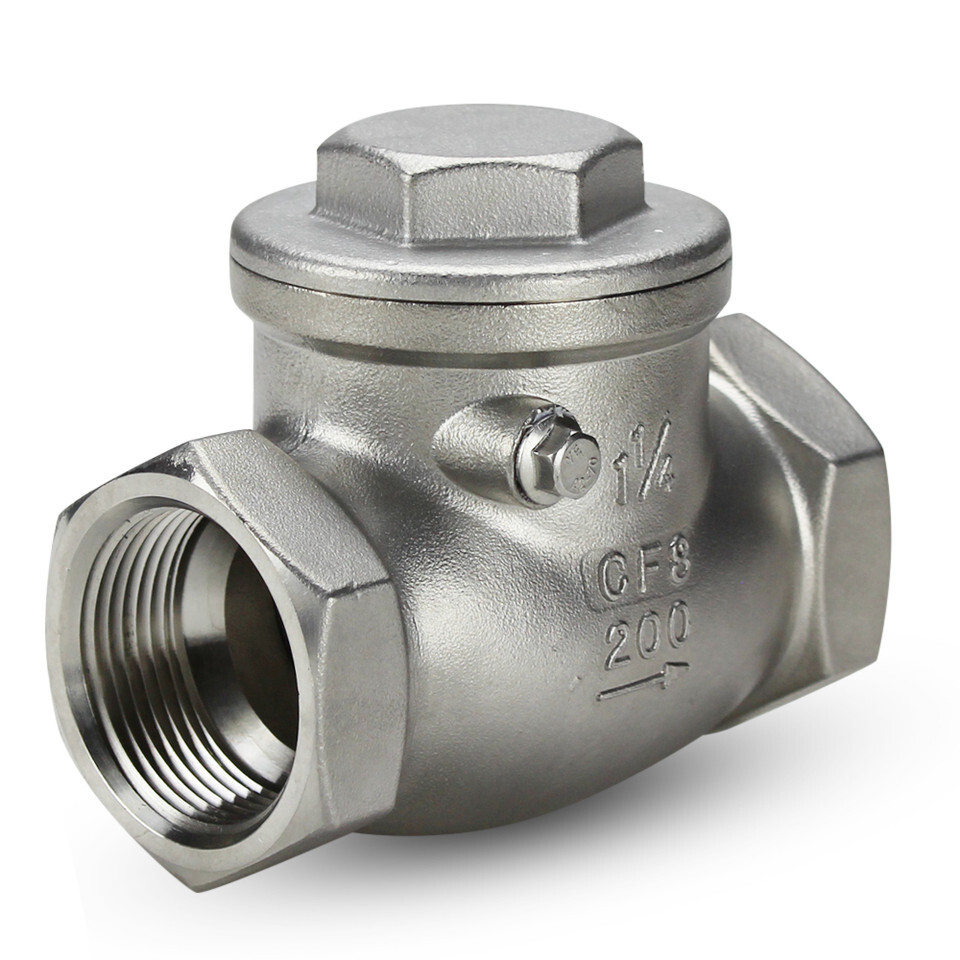
When fluid moves in the correct direction, the valve opens. If flow attempts to reverse, the valve closes to protect the system.
Common Check Valve Designs
| Check Valve Type | Mechanism | Typical Application |
|---|---|---|
| Swing Check Valve | Hinged disc | Water supply lines |
| Spring Check Valve | Spring-assisted poppet | Pump systems |
| Vertical Check Valve | Gravity-assisted disc | Vertical pipelines |
Check valves are commonly used in:
- pump discharge lines
- water heater installations
- irrigation systems
- backflow prevention assemblies
- fluid transfer lines
| BROWSE CHECK VALVES |
Check valves are essential because they help protect equipment and maintain system stability. However, they are not designed for active shutoff or automation. They only react to flow conditions.
Pressure Reducing Valves
Pressure reducing valves, often called PRVs, are used to lower and stabilize downstream water pressure.
Municipal water supply pressure is often higher than what plumbing fixtures, appliances, and branch lines are designed to handle. A pressure reducing valve helps maintain a safer and more consistent downstream pressure.
Key Characteristics of Pressure Reducing Valves
| Feature | Description |
|---|---|
| Control Type | Automatic mechanical |
| Internal Components | Spring and diaphragm |
| Adjustment | Manual pressure setting |
| Primary Function | Downstream pressure control |
Pressure reducing valves are commonly installed:
- at building water service entrances
- upstream of irrigation systems
- before appliances or sensitive equipment
- in systems that require stable fixture pressure
These valves regulate pressure, but they do not provide remote shutoff or electrical control.
Other Manual Plumbing Valve Types
Some plumbing systems also use gate valves and globe valves, although these are more common in industrial and legacy piping systems than in modern residential plumbing.
Gate valves use a sliding gate that moves vertically to open or close the flow path. They are designed primarily for full isolation and are often found in larger pipelines or municipal systems.
Globe valves use a movable plug and seat arrangement to regulate flow. Because the fluid path changes direction inside the valve body, globe valves create more pressure drop than ball valves, but they offer better throttling control.
These valve types still have a place in plumbing and process systems, but they are generally manual and are not typically the first choice for modern automated shutoff.
Solenoid Valves
Solenoid valves introduce electrical control into plumbing systems. Instead of relying on manual handle movement, they use an electromagnetic coil to move an internal plunger that opens or closes the valve.
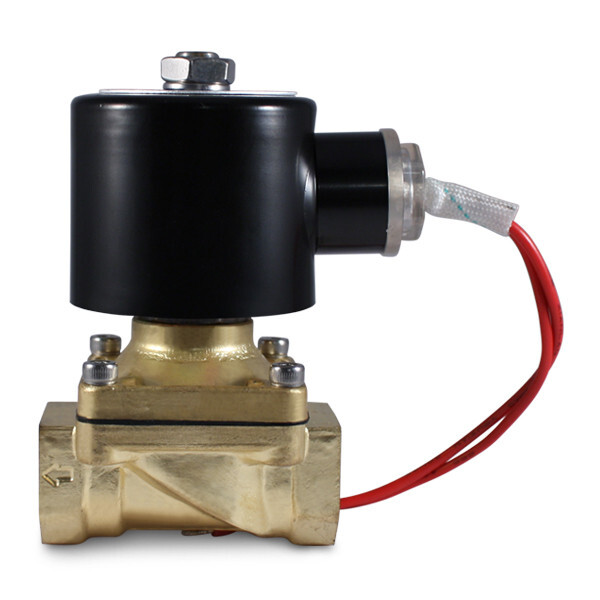
This makes them useful in systems that need automatic shutoff, sensor-based control, or rapid on-off operation.
Why Choose a Solenoid Valve
A solenoid valve is often chosen for:
- remote shutoff capability
- automatic leak prevention
- fast response to sensors and controllers
- integration with smart systems
- timed flow control
This makes solenoid valves a strong option for plumbing systems that need automatic response rather than manual intervention.
Basic Components of a Solenoid Valve
| Component | Function |
|---|---|
| Solenoid Coil | Generates magnetic field when energized |
| Plunger | Moves to open or close the valve |
| Valve Body | Directs and controls fluid flow |
Solenoid valves can be integrated with:
- leak detection systems
- irrigation controllers
- building automation systems
- programmable timers
- industrial control systems
Types of Solenoid Valves Used in Plumbing
| Type | Description | Typical Use |
|---|---|---|
| Direct Acting | Opens directly with magnetic force | Low flow systems |
| Pilot Operated | Uses system pressure to assist opening | Higher flow water lines |
| Normally Closed | Closed when power is off | Leak prevention |
| Normally Open | Open when power is off | Cooling or fail-open systems |
For many plumbing and water shutoff applications, normally closed solenoid valves are preferred because they stop flow automatically when power is removed.
That fail-closed behavior helps reduce risk during alarm events or system shutdowns.
| BROWSE SOLENOID VALVES |
Electric Ball Valves
An electric ball valve, also called a motorized ball valve, combines a standard ball valve with an electric actuator. Instead of turning the handle manually, the actuator rotates the ball open or closed when it receives an electrical signal.
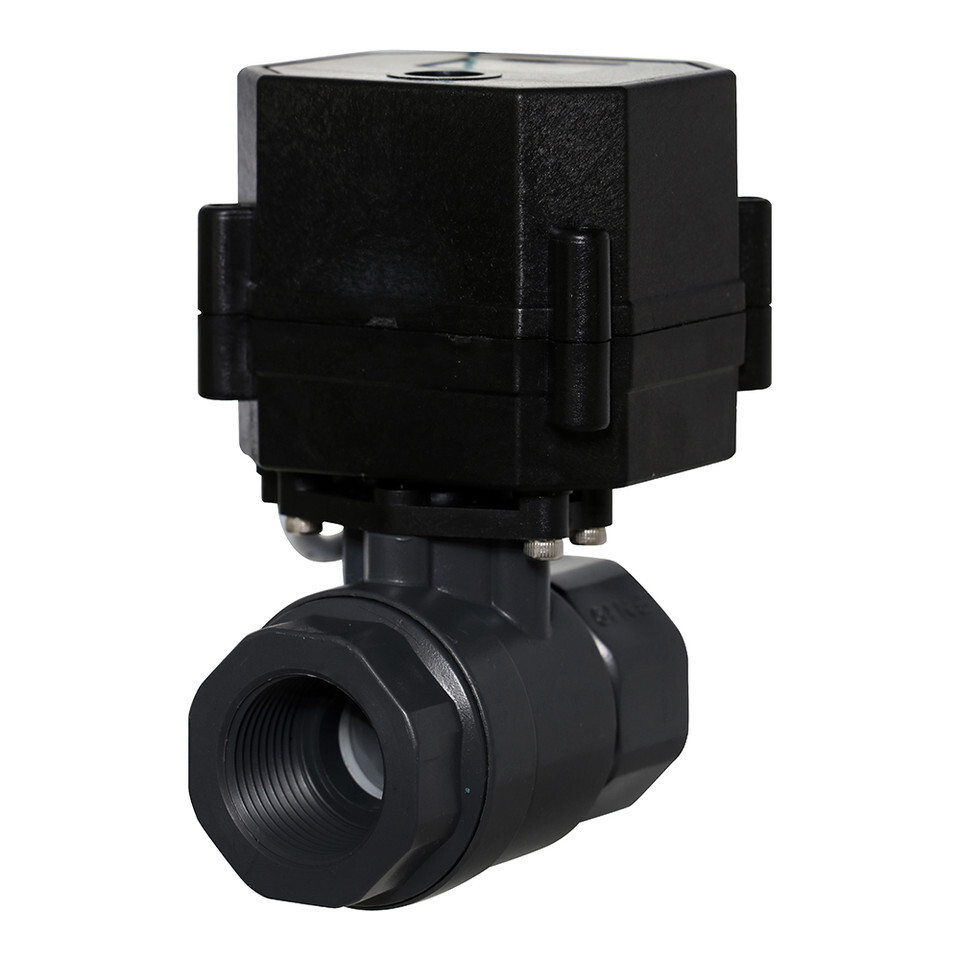
This gives the system the same basic shutoff function as a manual ball valve, but with remote or automatic operation.
Why Choose an Electric Ball Valve
Electric ball valves are often selected for:
- remote water shutoff
- automated plumbing control
- quarter-turn motorized operation
- full-port flow path in many designs
- applications where ball valve shutoff is preferred
They are commonly used in:
- building water shutoff systems
- smart home water control
- irrigation automation
- equipment isolation
- automated utility lines
If your application needs motorized shutoff using a ball valve design, browse our motorized ball valves to review available options.
| BROWSE ELECTRIC BALL VALVES |
In many plumbing applications, an electric ball valve is a strong alternative to a solenoid valve, especially when the goal is controlled shutoff of a water line rather than rapid cycling.
Solenoid Valve vs Electric Ball Valve
This is where people often get the decision wrong.
Both valve types support automation, but they operate differently and are not interchangeable in every application.
Solenoid Valve vs Electric Ball Valve Comparison
| Feature | Solenoid Valve | Electric Ball Valve |
|---|---|---|
| Operating Method | Electromagnetic coil moves plunger | Electric actuator rotates ball |
| Response Speed | Fast | Slower |
| Best Use | Fast automatic shutoff and control | Remote on-off isolation |
| Flow Path | Internal orifice based | Often full port |
| Common Media | Water, air, light fluids | Water and compatible fluids |
| Typical Application | Leak detection, timed control, automated equipment | Remote shutoff, plumbing automation, water isolation |
In general:
- choose a solenoid valve when you need fast response, sensor activation, or repeated automatic cycling
- choose an electric ball valve when you want motorized quarter-turn shutoff and a ball valve style flow path
- choose a manual ball valve when simple hand-operated isolation is enough
That distinction matters because some plumbing applications are better served by the shutoff style of a ball valve, while others benefit from the speed and compact control of a solenoid valve.
When a Solenoid Valve Is the Better Choice
A solenoid valve is often the better choice when the system requires quick electrical response and automatic control.
Typical use cases include:
- leak detection systems
- sensor-triggered shutoff
- automatic equipment control
- timed irrigation zones
- fast on-off fluid control
Remote Water Shutoff
Solenoid valves can shut off water flow when they receive a control signal from a panel, switch, or sensor.
This is commonly used in:
- smart leak protection systems
- building automation systems
- emergency shutoff systems
Leak Detection Systems
Water leak sensors can trigger a normally closed solenoid valve to shut off the supply automatically when moisture is detected.
This can help reduce property damage in residential, commercial, and equipment protection applications.
Automated Equipment
Many systems require fluid flow to start and stop automatically.
Examples include:
- beverage equipment
- laboratory instruments
- wash systems
- cooling systems
- process equipment
Timed Irrigation Systems
Irrigation controllers often use electrically actuated valves to automate watering schedules. In applications where fast electrical actuation is needed, a solenoid valve may be the preferred choice.
When an Electric Ball Valve Is the Better Choice
An electric ball valve is often the better choice when the application needs motorized shutoff using the same basic function as a standard ball valve.
Typical use cases include:
- remote main water shutoff
- automated branch line isolation
- smart plumbing control
- building water line automation
- on-off shutoff where quarter-turn ball valve operation is preferred
In these applications, the electric actuator provides automation while the valve itself retains the familiar shutoff design of a ball valve.
Comparing Manual Ball Valves, Solenoid Valves, and Electric Ball Valves
The table below provides a more practical selection view.
| Feature | Manual Ball Valve | Solenoid Valve | Electric Ball Valve |
|---|---|---|---|
| Operation | Hand operated | Electrically controlled | Electrically actuated |
| Automation | No | Yes | Yes |
| Remote Control | No | Yes | Yes |
| Response Speed | Manual | Fast | Moderate |
| Shutoff Style | Quarter turn | Internal plunger mechanism | Quarter turn |
| Best Use | Basic isolation | Fast automatic control | Motorized shutoff |
| Common Plumbing Role | Service shutoff | Sensor-based control | Remote water isolation |
Each valve type has a role.
Manual ball valves are ideal for simple plumbing isolation. Solenoid valves are ideal for fast automatic response. Electric ball valves are ideal for motorized shutoff using a ball valve design.
Choosing the Right Valve for Your Plumbing System
Selecting the correct valve depends on the actual job the valve needs to do.
Key considerations include:
- required flow rate
- operating pressure
- fluid compatibility
- installation environment
- voltage availability
- need for automation
- desired shutoff style
- control method
If the application only requires manual isolation, a manual ball valve is often the simplest and most cost-effective solution.
If the system needs fast automatic control from a sensor or timer, a solenoid valve is often the better fit.
If the system needs remote or automated shutoff but would benefit from quarter-turn ball valve operation, an electric ball valve may be the better choice.
The best answer depends on the system design, not just the label on the valve.
Explore Valve Options for Plumbing and Automation
Modern plumbing systems often require more than one type of valve. Manual valves handle service isolation. Check valves prevent backflow. Pressure-reducing valves stabilize pressure. Solenoid valves and electric ball valves add automation where manual operation is not enough.
Need help choosing the right valve for your application? Contact our team, and we will help you match the valve type, material, and control method to your plumbing system.
Related Products:
- Manual Ball Valves - Best for straightforward plumbing isolation, service shutoff, and maintenance access.
- Motorized Ball Valves - Good fit for remote shutoff, automated branch line isolation, and quarter-turn motorized control.
- Solenoid Valves - Good fit for automatic shutoff, sensor-based activation, and fast on-off control.
Recommended Next Read:
NPT Threading Explained
Phone: 800-983-8230
Email: sales@electricsolenoidvalves.com